Filing an income tax return in Pakistan is no longer complicated. The FBR IRIS Portal, operated by the Federal Board of Revenue, allows individuals and businesses to submit their returns digitally. Still, many people either delay filing or avoid it completely, due to a lack of clear guidance.
Whether you are a salaried employee, a freelancer, or a business owner, this complete guide will walk you through how to file your income tax return. From registration to submission, we will help you file your income tax return confidently and correctly.
What is an Income Tax Return?
An income tax return is a formal declaration of your income, expenses, taxes paid, and assets submitted to the government.
In Pakistan, the income tax return includes:
- Total annual incomes
- Taxes deducted
- Assets and liabilities
Based on this information, the FBR determines whether you:
- Need to pay additional tax
- Are you eligible for a refund
Step-by-Step: How to File Income Tax Return in Pakistan
Let’s walk through the actual process of filing your return using the FBR IRIS Portal.
Required Documents for Filing of Tax Return
- CNIC or passport number
- An active phone number registered in your name
- Valid email address
- Bank statements
- Salary slips or proof of income
- Business records
- Property and investment details
- Zakat or donation receipts
Most of these documents are submitted digitally through the IRIS FBR Portal.
Step 1: Register with FBR (Get Your NTN)
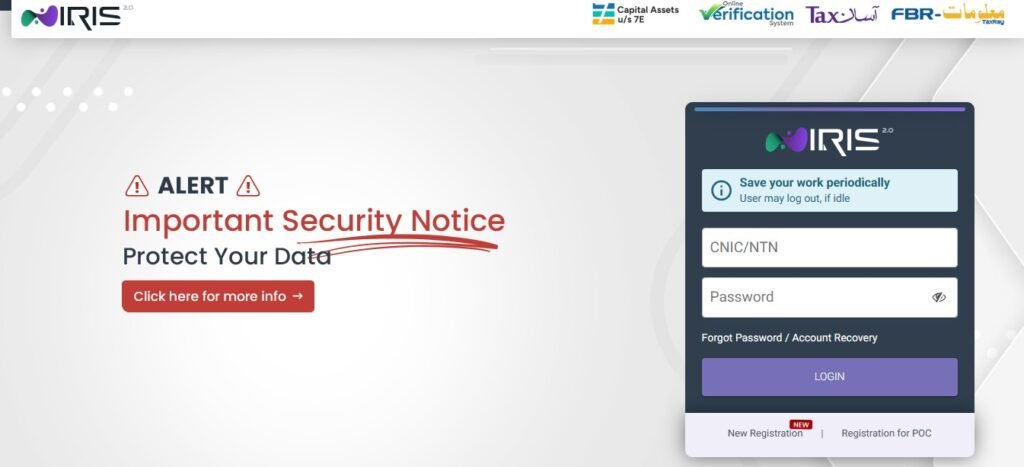
If you’re filing for the first time, you’ll need to register.
- Go to the FBR IRIS portal and select “Registration for Unregistered Person.”
- Enter your CNIC, phone number, and email. After verification through OTP, you’ll receive your login credentials.
This process creates your National Tax Number (NTN).
Step 2: Log in to the IRIS Portal
Use your CNIC and password to access your dashboard.
Once inside, you’ll see multiple options related to declarations, profiles, and notices.
Step 3: Open Your Tax Return Form
Click on “Declaration”, then select:
114(1) – Income Tax Return
Choose the relevant tax year and open the form in edit mode.
Step 4: Enter Your Income Details
This is the core of your return. You’ll need to declare all income sources, such as:
- Salary income
- Business income
- Freelance or foreign income
- Rental income
- Capital gains
Accuracy matters here. Your declared income should align with your banking activity and financial records.
Step 5: Adjust Withholding Taxes
In Pakistan, a significant portion of taxes is collected in advance through withholding.
This includes deductions on:
- Mobile usage
- Electricity bills
- Banking transactions
These amounts are already recorded and can be adjusted against your total tax liability.
Step 6: Complete Your Wealth Statement
This is one of the most important, and often misunderstood, parts of the process.
Your wealth statement includes:
- Assets (property, vehicles, cash, investments)
- Liabilities (loans, debts)
- Annual expenses
- Reconciliation of income
The purpose is to show how your wealth changed during the year.
If your assets don’t match your declared income, it can raise red flags, so take your time here.
Step 7: Review and Submit Your Return
Before submitting:
- Double-check all entries
- Ensure no section is left incomplete
- Confirm that income and expenses are accurately filled out
Once submitted, you’ll receive confirmation from the system.
What are the benefits of filing taxes online in Pakistan?
The following are some of the major advantages of submitting taxes online via the FBR tax portal:
Saving Time: File your tax return from anywhere and at any time without visiting tax offices. The tax portal makes it possible to get it all done in a few clicks from the comfort of your home or office. The efficiency saves them the paperwork and reduces the time needed to fill out the manual form.
Greater Accuracy: The system automatically verifies errors and ensures the tax is calculated accurately. The portal warns of common mistakes in your information, such as incorrect calculations or missing information. It also automatically fills in some pages with previous information, minimizing the risk of human error. IRIS ensures your return is filed appropriately, reducing the chances of penalties or audits.
Real Time Updates: Monitor the status of your tax return in real time. You can keep yourself up to date on whether your payment has been processed and accepted, or if it needs any additional details. This enables you to identify any problems and resolve them promptly for a flawless filing process.
Who Must File a Tax Return in Pakistan?
Individuals and businesses are required to file an income tax return in Pakistan if any of these apply to you. Many people quality, but they don’t know it.
- Salaried individuals earning more than 600,000 PKR per year or 50,000 PKR per month. If salary crosses this limit, filing is mandatory, not optional.
- Business Owners and Registered Companies of any size. Whether you are a small shop, a restaurant, a consultancy, or a trading business, if you generate income from business activity, you must file a return.
- Freelancers and remote workers earning through online platforms or foreign clients
- Property owners with assets worth PKR 5 million or more. If you own property or significant assets, FBR requires a wealth declaration annually.
- Investors in stocks, mutual funds, or real estate who earn dividends, capital gains, or rental income
- Individuals who own a vehicle of 1000cc or above
Why Filing Your Tax Returns Matters?
Many people assume tax filing is only about compliance; it goes beyond that.
When you file your return, you:
- Qualify for lower tax rates on transactions
- Become part of the Active Taxpayer List
- Avoid penalties and legal notices
- Build financial credibility for loans and visas
- Keep your financial records clean and documented
- Carry forward business losses for tax rebates
- Ability to claim a refund on excess tax paid and avoid double taxation
On the other hand, non-filers face higher taxes on property purchases, vehicle registration, banking transactions, and more.
Penalties for Non-Filers
Here are the penalties for not filing your tax return in Pakistan in 2026.
1. Higher Withholding Tax on Every Transaction
- Cash withdrawals from banks: 0.15% of Filers’, while 0.6% for non-filers on withdrawals above PKR 50,000
- Property Purchase Under Section 236 C: Filers pay 3%, non-Files pay double, i.e., 6%
- Vehicle Registration: Non-filers pay significantly higher advance tax compared to filers.
- Dividend Incomes: Non-filers are taxed at 15% compared to 7.5% for filers
- Prize Bond Winning: 25% for non-filers and 15% for filers
- Profit on debt (Bank Profit, Savings): Non-filers pay 15% vs 10% for filers
You can use our income tax calculator to calculate your exact liability as a filer and a non-filer.
2. FBR Audit and Unexplained Income Notice: FBR flags individuals with significant bank transactions, property transfers, vehicle purchases, etc., who don’t appear on the ATL. You may receive a formal FBR audit notice.
3. SIM Card Blockage: PTA may block the SIMs of non-filers
4. Travel Restrictions: Not universally enforced, but under the Income Tax Ordinance 2001, FBR can approach FIA to place tax evaders on the Exit Control List (ECL).
5. Banking Restrictions: Non-filers face restrictions on opening new bank accounts and may face scrutiny on existing accounts
Common Mistakes to Avoid
We have helped hundreds of individuals and businesses file taxes and fix problems. Here are the common mistakes we have seen people make when filing an annual income tax return with FBR.
- Filing under the wrong tax year
- Not declaring all income sources, especially freelance income
- Forgetting to include the wealth statement in Pakistan
- Missing out on eligible tax credits and deductions
- Using incorrect bank account details for a refund
- Not keeping the acknowledgment receipt after filing
- Filing late and incurring unnecessary penalties
Need help with annual income tax return filing? Our tax consultants can help you smoothly steer the path while preventing pitfalls.
Tax Filing Deadline in Pakistan
The standard deadline for filing income tax returns is:
30th September each year
However, extensions are sometimes granted by the Federal Board of Revenue. After filing, make sure you save the acknowledgment receipt. Moreover, we recommend using a browser on a laptop or PC; the mobile version can be glitchy and difficult to use.
FAQs
How much time is required to file a tax return in Pakistan?
Filing an income tax return in Pakistan typically takes 30 to 60 minutes for salaried individuals or simple cases, provided all documents are ready. For business owners or individuals with multiple income sources, investments, or complex wealth statements, the process may take several hours or more.
Is it necessary to file a wealth statement?
Yes, a wealth statement is mandatory when filing an income tax return in Pakistan. It provides a summary of your assets, liabilities, expenses, and income reconciliation, and must be submitted through the FBR IRIS Portal along with your return.
How to check tax filer status in Pakistan?
You can check your tax filer status by visiting the Federal Board of Revenue website and accessing the Active Taxpayer List. Enter your CNIC number to instantly confirm whether you are listed as an active filer.
Is online tax filing safe in Pakistan?
Yes, online tax filing in Pakistan is safe when done through the official FBR IRIS Portal. The system is secure, widely used, and managed by the Federal Board of Revenue, ensuring protection of your personal and financial data.
Can I file my tax return myself?
Yes, everyone can file their own tax return, especially for simple cases. If you are a big taxpayer or facing difficulty filing an income tax return, Pak Tax Calculator can help you easily file your income tax accurately.
Conclusion
Filing your income tax return in Pakistan is no longer something to avoid or delay. With the digital tools provided by the Federal Board of Revenue, the process has become simple, fast, and accessible.
More importantly, filing your return puts you in control of your financial record. It helps you save money through lower taxes, stay compliant with the law, and build credibility for future financial decisions.
Whether you’re a salaried employee, freelancer, or business owner, the sooner you start filing, the better positioned you’ll be financially.